August 2026
How do we build engineering experience?
What does it take to turn today’s emerging professionals into the people who will lead tomorrow’s biggest infrastructure projects? FutureNet offers a wider view of what’s possible.
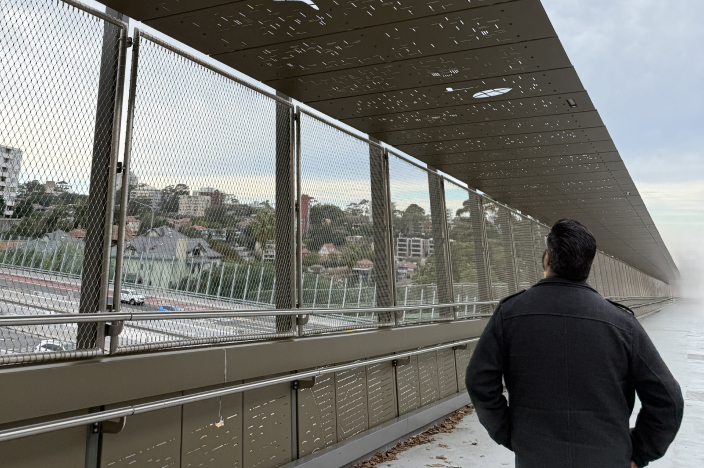
The Warringah Freeway Upgrade has been described as “open heart surgery” on Sydney’s transport network. Carrying around 250,000 vehicles a day, one of Australia’s busiest and most complex road corridors must function while the project team reconfigures up to 23 lanes of traffic, replaces or modifies 11 structures including road and pedestrian bridges, on and off ramps and underpasses and prepares the network for the future Western Harbour Tunnel.
This is no convenient blank canvas. New infrastructure must be woven through roads, ramps, utilities, retaining walls and structures built decades ago, while traffic keeps moving around it.
The challenge demands engineering talent and extraordinary collaboration. In March, the Warringah Freeway Upgrade received the Collaboration for Project Excellence Award at the Consult Australia Awards for Excellence. Jacobs and Arcadis, supported by CPB Contractors and DT Infrastructure, worked closely with Transport for NSW to integrate design, staging and construction sequencing in the live traffic environment.
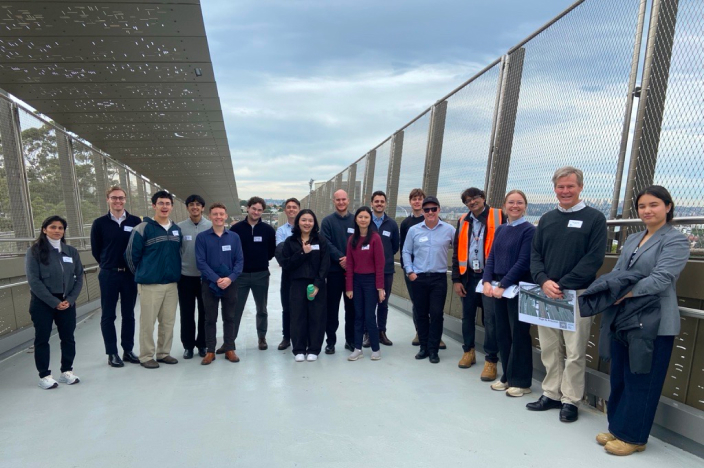
A few months after the award, FutureNet NSW took 52 emerging professionals behind the scenes.
“As engineering consultants, we don’t always get to see what we design being built,” says FutureNet NSW Chair Brendan Walton, a Principal Civil Engineer and Team Leader at Arcadis who worked on the project. “You can work on a set of drawings five years earlier, so to stand on site and see something become real is really exciting.”
Led by Brendan and Jacobs’ Director of Projects Tim Rodham, the FutureNet site tour began with an overview from Project Director Steven Clark and the Design Leadership Team of Philip McDonald and Philip Jennings. Participants could scan QR codes at key locations to pull up 3D GIS renders, connecting what they were seeing on site with the digital models behind the project.
Amy Costin, who manages FutureNet nationally for Consult Australia, saw something special. “You could feel the young professionals thinking: ‘I could be a part of a project like this’.”
How do we build the next generation of experts?
The question of how emerging professionals acquire experience has always mattered. It is about to matter much more.
Engineers Australia estimates the nation will need 150,000-plus additional engineers by 2036, as more than 70,000 professionals are expected to retire in the next decade.
Australia does not simply need more people with engineering qualifications. It needs to develop the people who will exercise judgement, lead teams and make difficult decisions on the projects of the future.
Professional careers have always started with a slightly inefficient apprenticeship model, but inefficiency was partly the education. Graduates undertook research, drafted documents, checked calculations, assembled presentations and reviewed data. Some of it was drudgery, but they also worked alongside more experienced people, watched how they approached problems and gradually cultivated judgement.
As artificial intelligence takes on the first draft and routine analysis, organisations may become more productive. But how does someone acquire senior judgement if the junior work that once helped build it disappears?
Professional development must become more deliberate and more varied. Forms of learning that sit outside task completion may become more valuable: seeing how work translates into the real world, engaging with experienced practitioners, asking questions and building relationships across the profession.
“Stepping out from behind the screen will become even more important,” as Amy says.
Experience, by design
Consult Australia established FutureNet in 2001 to bring together emerging professionals from across the design, advisory and engineering industries. FutureNet’s state-based committees build networks, develop non-technical skills and engage with the people, projects and issues shaping the industry.
As FutureNet focuses on the early stages of professional growth, Consult Australia’s Future Leaders Program also supports career development. Together, the two initiatives help to grow the next generation of leaders.
“FutureNet’s purpose is in the name. It is a future network and members work together to create career and learning opportunities,” Amy says. “They know what young professionals are interested in – the projects they want to explore, the policy questions they want to debate and the events they want to create.”
Across New South Wales, Victoria, Queensland, South Australia and Western Australia, FutureNet committees organise events and build relationships across organisations and disciplines. In doing so, they create something that can be difficult to acquire within the boundaries of a single job: a wider view of the profession.
Some FutureNet committees have waiting lists, while others are actively recruiting new members, Amy notes.
For Brendan, who has been passionate about professional development since his university days, that cross-industry exposure is part of FutureNet’s value.
“FutureNet focuses on what matters to consultants and what impacts them on a day-to-day basis. It’s about the lessons we can share, the training we can create and what we can do to empower young professionals.”
Amy has seen FutureNet committee members develop networks with senior leaders who might otherwise sit well outside their professional orbit. On the Warringah Freeway Upgrade site tour, experienced people working on one of Australia’s most demanding infrastructure projects gave their time to explain not only what they had built, but the decisions they made.
Australia needs more engineers. But headcount alone will not deliver the next generation of infrastructure.
“There is definitely a generation of young professionals coming through with a different view of how we’re going to work as consultants,” Brendan adds. “It’s up to us as leaders to think about what their roles will look like and how we help them develop.”
Contact Amy Costin, Consult Australia’s Event Manager, to learn more about FutureNet or gain regular updates on FutureNet activities on LinkedIn.