September 2026
Engineering humanity
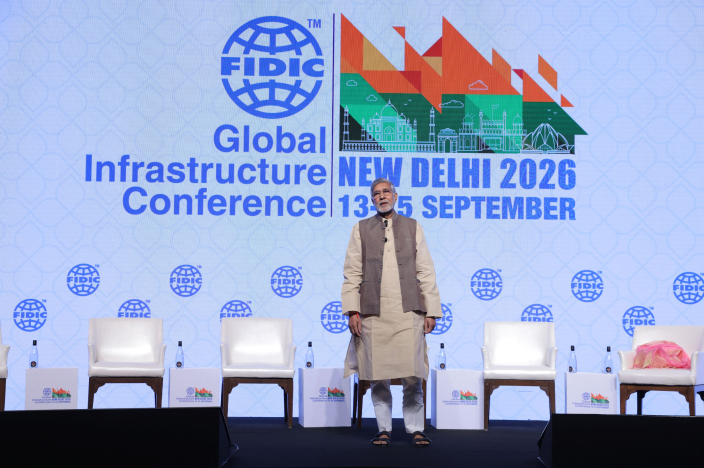
FIDIC Global Infrastructure Conference 2026
What happens when an engineer wins the Nobel Peace Prize? At FIDIC’s Global Infrastructure Conference 2026 in New Delhi, Kailash Satyarthi returned to his first profession with a challenge.
Consult Australia is Australia’s member association of the International Federation of Consulting Engineers (FIDIC), the global representative body for the consulting engineering industry, with national member associations in more than 100 countries.
Each year, FIDIC’s Global Infrastructure Conference brings the profession together to grapple with the big challenges shaping infrastructure around the world.
“Once upon a time, I was also an engineer,” Kailash Satyarthi told the audience.
Kailash is the only qualified engineer to have received the Nobel Peace Prize, and FIDIC was his first address to engineers since leaving the profession decades ago. He told delegates he had given up his engineering career, but never the engineer inside him – “thinking in systems, understanding the deeper, more profound issues.”
Kailash traced the origin of his life’s work back to the age of five, on his first day of school. “I saw a boy my age shining shoes,” he said. “I asked why he wasn’t in class. I was told that poor children have to work.” That single encounter, he said, set the course of his life. “That child’s eyes followed me for all my life.”
A bigger brief for engineers
The Indian social reformer has devoted decades to campaign against child labour and for the universal right to education. In 2014, Kailash was the co-recipient of the Nobel Peace Prize, along with Malala Yousafzai, “for their struggle against the suppression of children and young people and for the right of all children to education”.
He put a direct question to the room: “What are you building, in construction and engineering? Humanity. There is often a gap between that and industry and business.” Quality, he said, is usually understood in terms of strength, safety and durability – all essential, but not sufficient on their own. Engineers, he suggested, carry a moral purpose that runs deeper than the technical brief.
He urged delegates to think through the consequences of what they build – the impact on the environment and on people, including the people who supply the materials engineers work with. “Are they being paid well?” he asked, pointing to the work of his own organisation, Bachpan Bachao Andolan, in rescuing children who had been “bought and sold like animals”.
Physical infrastructure, he argued, is only one part of the picture. “You are not just an engineer. You are a world citizen. There is interconnectedness with everything that you do.”
Alongside physical infrastructure, he said, societies need social infrastructure – built on education, healthcare and social security – which remains lacking across much of the world, even where governments and international institutions exist. “Can we say that humanity is safe?”
Building compassion into designs
The heart of Kailash’s address was a call for what he termed “mindful problem solving”.
“When you feel the problems of others as your problem, and act mindfully to solve them, that is compassion,” he said. He asked engineers to build compassion into their designs from the outset: “Can the poor people living in these communities get access to what you are constructing? Think right from the beginning. Compassionate infrastructure building.”
Kailash connected this directly to his decades-long campaign against child labour, describing his call to “mobilise the masses” and press for laws that eliminate it outright. Education, he said, “is a right, not a privilege” – a force for enlightenment and growth, and the key that opens up all other rights. He has travelled to 140 countries in pursuit of that goal.
He closed with two personal stories. The first returned to the boy he saw at five years old, the encounter that trained his heart, he said, “as a compassionate human being who can feel the problems of others,” alongside a mind trained as an engineer.
The second was of a boy he met in a refugee camp in Germany, who had fled Syria and lost his legs and his mother in the process. Kailash asked him whether he wanted to stay in Germany or return home. The boy said he wanted to study engineering and go back to rebuild his village and his country. “That is what engineering can do,” Satyarthi said. “It gave me inspiration.”
He left delegates with a challenge to carry through the rest of the conference: “You have constructed many things of which you can be proud. But what are you going to construct that will make a significant difference to the community of 8.5 billion citizens for generations to come?”
This article first appeared on the FIDIC website and has been adapted for Consulting Matters.
Image: Nobel Peace Laureate Kailash Satyarthi speaking on the second day of FIDIC’s Global Infrastructure Conference 2026 in New Delhi.