October 2026
Changing who chooses construction
Women make up just a fifth of Australian engineering enrolments. Northrop Principal Structural Engineer Isabel Duffy wants to help built environment firms stop fishing from the same small pool.
For an industry full of firms with targets to recruit more women, the maths is unforgiving.
The Australian Government’s STEM Equity Monitor shows the share of Australian engineering enrolments rose from 15% in 2015 to 21% in 2024. But the graduate pool is small: 2,000 women completed an engineering qualification, compared with around 10,000 men.
As a shareholder and business leader at Consult Australia member firm Northrop, Isabel Duffy has watched these numbers for years. Northrop’s workforce is already around 30% female, but individual firms improving their own numbers won’t solve
the industry-wide problem, Isabel says.
“I could see this mismatch between industry ambition and the appetite of the next generation. I thought: what if we stopped competing for the women already in the pipeline and worked together to make the pool bigger?”
The choices made at 15
The STEM Equity Monitor shows just 34% of girls in primary
and secondary school are interested in studying engineering, compared with 65% of boys. By higher education, the gender gap is wider: 28% of young women are interested, compared with 57% of young men.
 Isabel understands how easily engineering can remain invisible.
“When you’re in high school and you’re
not quite sure what you want to do, it’s so overwhelming. You go to a university open day and there are all these faculties competing with each other. It’s not clear what your options are. I knew I loved design, but I didn’t even
know about the types of jobs that existed.”
In 2024, Isabel co-founded Tomorrow’s Women in Construction (TWIC), a not-for-profit that offers “the platform I wished
I’d had in high school to help girls make informed choices about careers in construction”.
TWIC uses “construction” as a catch-all term for the extraordinary range of careers across the built environment. Its website now features the career stories of more than 200 real women:
what they do, what a day in their life looks like, the education pathway they chose and what advice they would give a young woman choosing a career.
“It’s a relatable database that we hope will be a resource for girls in school, but also for parents and teachers to understand our industry a bit better.”
Isabel has watched what happens when girls are simply shown the possibilities. Each year, she returns to her own high school to talk about engineering.
“A few years ago, engineering became the most popular degree at my high school. They have an engineering class now and up to 40 girls every year are choosing to study engineering at uni. And it’s not because the girls are different or the
degree is different. It's just because the girls know what it is.”
From seeing to doing
There are other signs that exposure works. Last month, around 400 Year 8 girls from 40-plus New South Wales schools took part in Pitch for the Planet,
a four-day challenge run by The Orbispace Initiative to encourage more young women to pursue STEM education and careers.
Engineers Australia’s Chief Engineer Katherine Richards AM is the Initiative’s inaugural Engineering Ambassador. More than 80% of previous program participants have subsequently chosen STEM electives.
TWIC has taken this a step further. “Many schools are fully stretched and might have one career advisor supporting three schools,” Isabel says. “We kept getting this feedback that the number one thing we could do to help was to facilitate
a work experience program.”
In 2025, TWIC placed 85 girls with host companies for a week. This year, 250-plus girls across Sydney signed up for work experience, with more than 100 companies agreeing to take at least one student. Each student was matched with an employer based on her interests and location.
“These are all businesses that are frustrated they’re not getting the pipeline of students coming through from university and want to help do something about it.”
The program was supported by major partner Western Sydney University, which also hosted an end-of-week event, bringing the students together to share their experiences and learn about potential future study pathways.
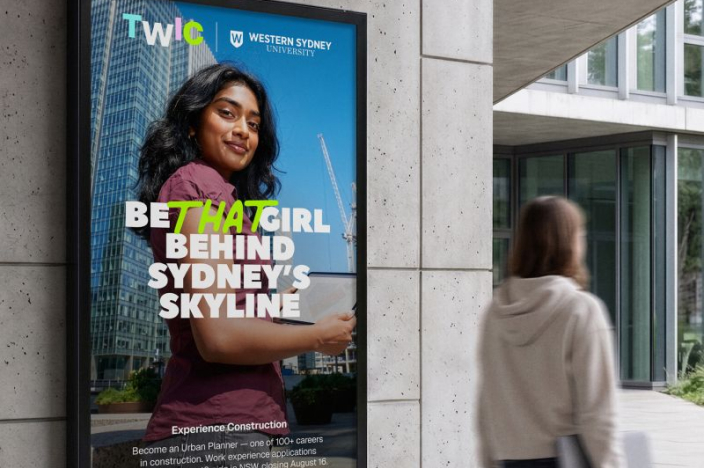
Work experience can reach hundreds of girls, “but TWIC is aiming bigger, wanting to change the perception of construction for thousands more”. In August, TWIC’s This is Construction campaign appeared on more than 80 billboards
around Sydney schools and transport hubs.
“We wanted it to look nothing like traditional construction advertising. We wanted to inspire young women to ‘be that girl behind Sydney’s skyline’ or ‘that girl who earns while she learns’.”
She doesn't dismiss the reasons for the industry's image problem – and the TWIC website has a helpful section on myth-busting.
“Everyone sees stories in the media about corruption, safety and harassment. And there are challenges in construction – but it has come a long way, with best-practise parental leave policies and inclusive hiring and retention initiatives.
We reckon it needs a make-over. It is also a very rewarding industry. It’s so tangible – we are part of the solution for so many massive problems, from the housing crisis to climate change.”
Beyond recruitment
With women accounting for around 12% of the broader construction workforce, TWIC estimates around 10,000 girls will need to choose careers in construction by 2030 to shift that figure to 15%.

Isabel’s work was recognised this year with the NAWIC's $15,000 Emerging Leader Scholarship,
supported by the NSW Government’s Women in Construction Program. She is using the scholarship to study
social impact and business leadership at UTS.
Meanwhile, a new national Champions of Change Engineers Group has set an ambition for women to make up at least 40% of Australia’s
engineering workforce by 2040. Engineers Australia is the profession and evidence partner, while Consult Australia brings its experience working with engineering consulting employers as an employer and implementation partner.
The Champions of Change Engineers Group will test and share practical interventions that address barriers across education, project allocation, work design, caring transitions, progression, leadership, professional norms and system settings.
Attracting, retaining and promoting women in engineering and construction is a complex problem – but building awareness of career options doesn’t have to be, Isabel says.
“TWIC isn’t trying to solve all facets of what is undoubtably a systemic problem. We know the industry needs many organisations working together to make a difference. We’re just trying to tackle one part of it – awareness.
Because fundamentally, you can’t be what you can’t see.”