November 2026
Someone always pays
Jonathan Cartledge, Chief Executive Officer, Consult Australia
Imagine if every Consult Australia member firm could print a running receipt of the costs incurred simply to compete for work.
Prequalification and registration fees. Financial disclosures and detailed CVs. Cybersecurity assessments and sustainability reporting. Tender interviews, carefully crafted submissions and endless requests for clarification. Legal advice to negotiate amendments to standard contracts.
Each requirement may be reasonable in isolation. But every request for “just one more thing” adds to the bill and the costs add up quickly.
One Consult Australia member recently told me that a single additional government reporting requirement was costing the firm $150,000 a year. Multiply that, potentially, across thousands of businesses, hundreds of procurement processes and three levels of government, and the receipt is very long.
Our 2026 Market Conditions Report revealed that compliance costs account for an average of 11% of respondents’ business budgets. Professional registration, licensing, insurance, privacy and data security were among the leading sources of increasing expenditure. That’s before we consider the costs of competing for work.
Building What Australia Needs, a new report from the Committee for Economic Development of Australia (CEDA), in partnership with WSP, illustrates this point. The report notes that Queensland’s government construction procurement framework alone spans more than 15 documents and 1,000 pages.
Procurement has a cost, whether we measure it or not, and the consequences extend beyond the cost of preparing a bid. Australia’s construction productivity is now 7% lower than it was in 1990, the report shows. While procurement is far from the only factor, there is a compelling case to start there.
Someone always pays. Our 2026 market conditions research found that 92% of surveyed firms had not passed on their full cost increases. And sure, some of these costs are absorbed by businesses. But some are reflected in future bids.
Every dollar spent navigating unnecessary complexity is a dollar that cannot be invested in skills, digital transformation or innovation.
The problem isn’t just the volume of paperwork. It’s also the contractual obligations that can transfer unreasonable risks to consulting businesses, adding costs that ultimately have to be borne somewhere.
Consult Australia has long advocated for fairer contracts and more consistent professional practices across Australia. We also help our members navigate the system as it stands.
This year, Consult Australia’s Contracts for Consultants course, led by the brilliant Tony Horan, trained our 3,000th practitioner Aurecon’s Sarah Bridges. Tony, who received our President’s Award in 2026, has made an extraordinary contribution to helping consulting businesses understand their contractual obligations, negotiate fairer terms and manage risk.
It’s a milestone worthy of popping a champagne cork. But wouldn’t it be better if we could spend less time negotiating unnecessary complexity in the first place?
Ultimately, value for money should account for the cost of obtaining that value.
The next time clients ask businesses for “just one more thing”, we would love them to ask two questions first: What value will this deliver? And who will pay for it?
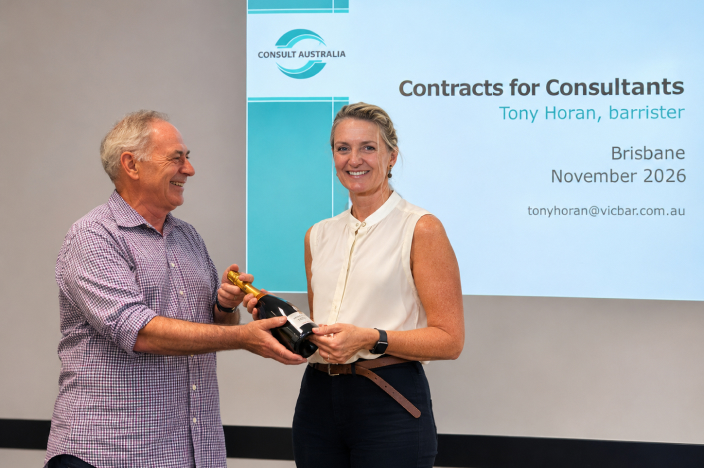
Tony Horan celebrates training 3,000 practitioners through Consult Australia’s Contracts for Consultants course with Sarah Bridges, Group Leader, Buildings – Queensland, Aurecon.