November 2026
Digital by default

Digital investment, analogue thinking?
“Businesses in Australia’s infrastructure sector are investing in digital capability, but this won’t boost productivity if the wider system remains fragmented,” says Consult Australia’s National Policy Manager, Kristine Banks.
In 1987, Nobel Prize-winning economist Robert Solow famously observed: “You can see the computer age everywhere but in the productivity statistics.” Almost 40 years later, a new federal parliamentary inquiry is asking why technological advances don’t always translate into productivity gains.
The inquiry is especially important in the construction sector, where productivity has flatlined for two decades.
Yet businesses are investing in technology. Infrastructure Australia’s 2025 survey found 64% of building and construction organisations had invested in data and digitalisation over the previous 12 months.
Australia’s productivity opportunity is not simply about greater use of technology, Consult Australia’s submission to the inquiry notes.
“We must get better at using digital information and tools to improve how infrastructure is planned, designed, assured, delivered and operated,” Kristine says.
Consult Australia’s Enabling Digital by Default paper identifies several barriers to progress, including fragmented information requirements, varying levels of digital capability among government clients and inconsistent approaches across jurisdictions.
“Consult Australia consistently hears that businesses cannot readily reuse the same systems, processes and capability from one jurisdiction or project to another. Instead, they must respond to different client requirements, procurement settings and information standards, which adds complexity and cost, while weakening the return on its digital investment.”
Consult Australia’s submission provides three recommendations to help establish a national approach and translate digital investment into productivity gains:
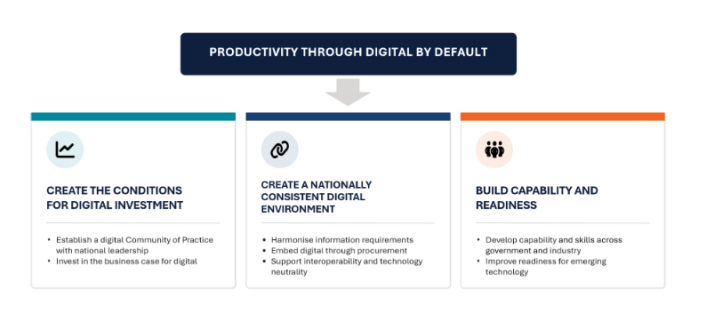
International approaches are instructive, and Kristine points to the United Kingdom and Singapore as examples.
Closer to home, the NSW Infrastructure Digitalisation and Data Policy will take effect in April 2027. “This policy recognises that digital transformation is not solely a technology issue. It is a step in the right direction. But to realise the full benefits of digitalisation, we need greater consistency across state borders.”
Among Consult Australia’s recommendations is a proposal to elevate infrastructure digitalisation to the Infrastructure and Transport Ministers’ Meeting as a national infrastructure productivity priority.
“We need a national forum to share what works, align where it matters and establish the common foundations for Digital by Default.”
Read the Consult Australia’s submission to the parliamentary inquiry or download Consult Australia’s full suite of government submissions for 2026.