May 2026
Emerging leader on the move
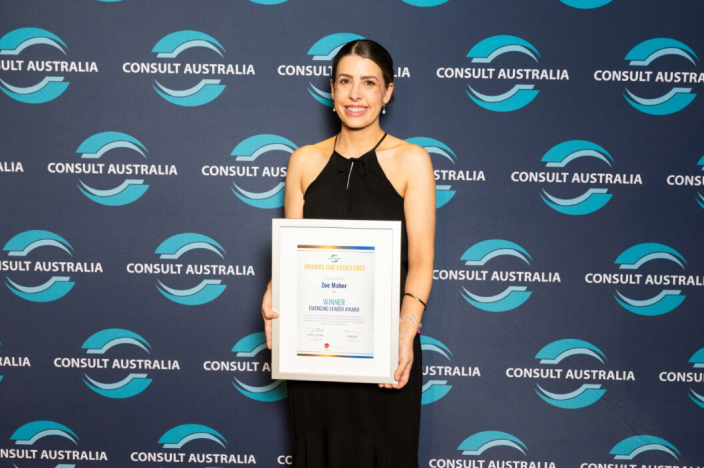
WSP’s Zoe Maher is challenging the way Australians think about public transport. “It’s not our job to force people onto trains and buses. It’s to make public transport so attractive that people want to use it.”
Over the past four years, Zoe has been busy working towards her mission to improve Australia’s public transport. She has established WSP’s high performing Strategic Rail Planning team in WA, helped deliver major METRONET and PTA rail projects, was appointed a Fellow by Engineers Australia and won notable peer nominated awards across the industry.
Just this March, she was named as the 2026 Emerging Leader at the National Consult Australia Awards for Excellence.
With so many strong finalists in her category, being shortlisted alone already felt significant, Zoe says. “When my flights were booked from Perth to Sydney for the awards, I was so grateful just to be there to accept the recognition as a finalist. When my name was read out as the winner, I couldn’t believe it.”
Following her win, Zoe was appointed Regional Executive for Rail in Western Australia at WSP in April 2026 – a role she had been striving towards, but thought was still some time away.
“The last few months have been just an incredible whirlwind for me career-wise. If I had to guess the key ingredients to my success in my career, particularly of late, I think it’s because I have been relentlessly empowered by those I work with and I’m genuinely just incredibly passionate about trying to create a meaningful difference in people’s lives.”
For Zoe, transport is not just about infrastructure delivery and getting people from A to B. It’s about systems that support daily life, equality, and opportunity.
On the right track
Zoe’s “obsession” with improving mobility began early in her career, during a stint in Birmingham, UK as a graduate transport engineer.
“I’d see people on the trains in Birmingham or the Tube in London in suits or ball gowns on their way to a gala, or students on their way to school, families out for a day with the kids – everyone used it. It wasn’t just for white collar workers getting to the city for work. It was a true public service for everyone.”
With Australia’s public transport networks improving significantly in recent years, Zoe points to Perth, where investments in METRONET have significantly “moved the needle”.
However, she believes that Australian cities still underestimate what makes mass transit appealing. “We need to consider all of the key ingredients of affordability, efficiency, reliability, and accessibility,” she says.
“Just last year, public transport has become significantly more affordable across many Australian cities. Among the big issues Australia needs to tackle next are improving the frequency of our rail, bus and light rail systems, improving reliability – both real and perceived – through priority, information and maintenance measures, and better connecting centres beyond our CBDs.”
Perth’s rail network, she argues, was largely designed to move workers into the CBD, where employment patterns have traditionally been shaped by male-dominated industries. “Our universities, hospitals and major shopping centres are not well served by rail – and these are sectors where women dominate employment,” she points out.
“Fifty per cent of the population is female. If we want more people using public transport, what a huge opportunity to start there. If we want more equitable cities and public transport that is a true public service, we need to think differently about the destinations we prioritise with our rapid public transport systems.”
Women are also overwhelmingly responsible for childcare, including school and daycare pick up and drop offs. One Sydney study on active transport, for instance, found 67% of stops made by women during daily journeys are related to caring responsibilities.
“In Melbourne, the latest data shows mums are responsible for over 70% of daycare and school drop offs.” Most public transport networks are designed assuming a linear commute that is largely focused on getting people to and from work. “This misses the journeys not associated with work-based trips and largely doesn’t consider the necessary ‘trip chaining’ associated with other responsibilities.
“There are so many fantastic opportunities with this including practical design solutions like placing daycare centres and small grocery stores at the doorstep of major public transport hubs.”
All aboard
Zoe is fascinated by how people perceive public transport. Many studies have found commuters favour trams over buses because they think light rail is more reliable, “even when the actual service outcomes are similar”.
“Just covering the wheels and providing a vehicle that looks and ‘feels’ like light rail can impact sentiment and uptake of that service. Simple measures like proving live bus or light rail arrival data, dedicated public transport lanes and priority signalling through intersections can make an enormous difference to actual and perceived reliability of those services. Electronic signage showing when the bus is actually arriving – not a sticker of when it’s supposed to – provides people comfort that they can rely on the service.”
The design of Brisbane Metro buses is a clever example of this. The bi-articulated buses resemble light rail with covered wheels and step-free boarding. Providing that reliable, comfortable and efficient services connecting to all types of centres around our cities is a crucial ingredient in society balancing the scales in terms of equity. “I genuinely just love the part I get to play in planning and designing systems that are an enormous part of people’s everyday lives”.
“No city can afford to put rail everywhere. And notably it's not always the right answer. Buses and light rail serve an incredibly important role in connecting our cities.
Rewriting the route map
Being a people leader in the infrastructure sector, Zoe is acutely aware of how a diverse workforce can support a more equitable world.
WSP Australia has a long-standing commitment to diversity. President and Managing Director Greg Kane chairs the Consult Australia Champions of Change coalition, while WSP has been recognised as a WGEA Employer of Choice for Gender Equality for eight consecutive years.
Zoe won a Global Excellence Award with WSP in May for her commitment to inclusion and belonging, which she will be accepting in Montreal, Canada, next month along with the other category winners from across the globe at WSP.
“If we want cities and infrastructure that truly work for everyone, they must be designed by diverse teams. We each bring our unique background and perspective to the way we approach our work – often subconsciously,” Zoe says.
“When I’m working on a new rail station, I instinctively think about how it would feel to navigate that space with my two-year-old. That lived experience changes the way I design. Diversity isn’t a box to tick; when our workforce truly reflects the diversity of communities we design for, that’s when engineers deliver their greatest impact.
“The ultimate dream is to find a career that is both meaningful and joyful and I’m incredibly grateful to have found that. Every day, I get to contribute to designing transport systems that shape how people experience their world, and hopefully make those journeys a little more seamless, equitable and even joyful. Perhaps even more importantly, I have the opportunity to empower others to do the same, multiplying the impact we can create together.”