July 2026
The age of convergence
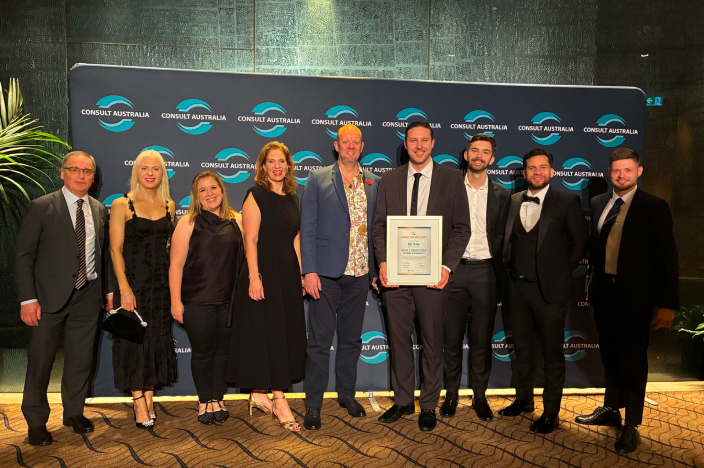
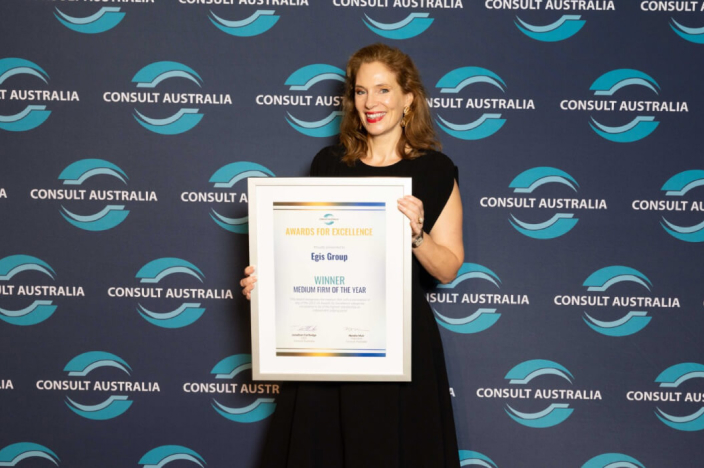
Winning Medium Firm of the Year at the Consult Australia Awards for Excellence recognises what Egis has achieved. But Managing Director Rowenna Walker is also interested in what consulting firms become next.
As technology reshapes the engineering profession, and as asset owners demand more value across the full lifecycle of infrastructure, Rowenna believes success will increasingly come from connecting disciplines, data and human judgement.
For decades, engineering consulting has been organised like a relay race. Design. Build. Operate. Maintain. Knowledge flowed in one direction.
Every motorway, railway, tunnel and hospital has been generating operational knowledge that largely sits in separate organisations. The design team rarely learns what happens a decade after delivery and maintenance teams learn lessons that rarely make it into the next project.
For Rowenna Walker, the consulting firms that thrive over the next decade won’t simply move projects from one phase to the next. They’ll connect them.
Thinking like an owner
Headquartered in France, Egis entered the Australian market 40 years ago as a provider of operation and maintenance contracts in tunnels and roads. Today, the company’s 23,500-strong workforce operates across 70-plus countries.
In Australia, Egis has expanded rapidly over the last three years through a series of acquisitions and now boasts a team of 1,000 across 17 locations. In March, Egis was presented with the Medium Firm of the Year accolade at the Consult Australia Awards for Excellence.
Rowenna, who joined Egis in September 2025 after nearly a decade with Aurecon, was a director of Consult Australia for six years, culminating in a stint as national president. She says Egis’ business model changes the way its engineers think.
“Around 20% of Egis’ business is in the operation and maintenance of assets. When you’re purely in front-end design and not exposed to the downstream full lifecycle of asset operations, you just don’t know what you don’t know.”
In June, Transurban appointed Egis as its long-term incident response and maintenance partner for its southern Sydney motorway network, including WestConnex, the Eastern Distributor and the Cross City Tunnel. It’s an appointment that reflects Egis’ operational knowledge and signals a broader industry shift, Rowenna notes.
“Owners are placing greater emphasis on whole-of-life performance, resilience and operational costs rather than simply minimising capital expenditure. Consultants who understand what happens after handover are increasingly able to influence decisions made long before construction begins.
“The firms best positioned for the future won't just design assets. They'll understand how those assets perform, fail, adapt and deliver value over their entire life.”
For Rowenna, that means thinking not just like a designer, but more like an owner.
From silos to systems
Rowenna’s view is echoed by the World Economic Forum (WEF). In April, WEF published Technology convergence: The new logic for competitive advantage, arguing that artificial intelligence, robotics, quantum computing and other technologies are forcing integration between industries, value chains, organisations, disciplines and business functions.
“Industry winners are not the most technically advanced, but the most ready to integrate,” the report’s authors argue, pointing to engineering design, operations and maintenance as one example.
AI tools, like copilots and agents, “are set to translate fragmented operational data into decisions, instructions and automated actions across engineering, maintenance and procurement to shift differentiation from possession of data in the cloud to how an enterprise actions it”.
In other words, every maintenance issue, customer complaint, equipment failure and operational success becomes intelligence that improves the next design.
McKinsey sees the commercial implications. As global infrastructure investment races towards an estimated US$106 trillion by 2040, McKinsey argues the greatest opportunities won't come simply from building more assets, but from improving how they perform throughout their lifecycle.
In this future, operational insight doesn’t sit at the end of a project. It becomes part of the engineering process itself.
The business of judgement
Convergence has another consequence. It changes what clients value.
The World Economic Forum argues that convergence is “a leadership and operational issue, not solely a technological one”. As technology automates tasks such as modelling, drawings and reporting, Rowenna believes engineering firms will need to rethink what they are really selling.
“Engineering firms have traditionally been paid by the hour for the people they have on a project. But what is the value of the advice that we’re providing? Because that’s what the future looks like: getting paid on value, not on hours per person.”
Technology can generate options. Experience, exposure and learning from others determine which option is right.
“We learn when things don't feel or look right, when a model doesn't reflect reality. How do you train people to determine that an AI generated output is giving you rubbish?”
In the age of convergence, competitive advantage won’t simply come from connecting systems. It will come from combining those connected systems with human judgement. “That's what clients will continue to pay for and ultimately, what they will value most,” Rowenna concludes.