July 2026
Net zero concrete needs more than new chemistry
The next chapter of concrete innovation won’t start with a technical solution or a miracle material. It will be defined by the industry’s ability to work together, says the SmartCrete CRC team.
Concrete is the world’s most widely used construction material, but producing it generates an estimated 6–8% of global carbon emissions.
Solving that challenge is the focus of SmartCrete CRC, an independent cooperative research centre established in 2020. Backed by $66.8 million from government, industry and universities, it brings together researchers and practitioners to develop the next generation of lower-carbon concrete and to understand how those innovations can move from laboratory to construction site.
The biggest barriers to low-carbon concrete are not technical. This was one of the strongest messages to emerge from the recent Future Concrete Leaders event series, presented by SmartCrete CRC and Concrete Institute of Australia’s NexGen community.
Bringing together undergraduate students, PhD candidates, early-career researchers and industry professionals, the events explored the future of concrete engineering.
“The event series provided a space to discuss where the industry was heading, the challenges we needed to solve and the opportunities that lie ahead,” says Estelle Clapham, SmartCrete CRC Education Manager.
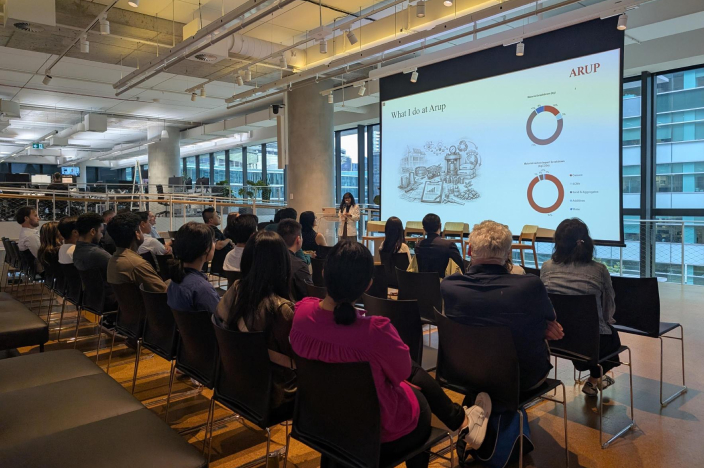
Events hosted by Arup in Melbourne, GHD in Perth and WSP in Adelaide explored topics ranging from sustainability and emerging materials to digital transformation, technological innovation and future skills. Other events were held with Lendlease in Sydney and BG&E in Brisbane.
“Most importantly, emerging professionals could ask questions, explore ideas and build meaningful connections with those already leading the industry – because the challenge is not material science but commercial adoption.”
SmartCrete CRC has supported 53 research projects over the last six years. One project is investigating calcined clay concrete, a promising alternative as traditional supplementary cementitious materials such as fly ash and slag become scarcer as coal-fired power stations close. Using abundant clay resources, the material has the potential to reduce carbon emissions by 30–40% while maintaining the performance engineers expect.
Another project is rethinking waste. Australia produces around 30 million cubic metres of ready-mix concrete each year, with an estimated 1.2 million cubic metres returned unused. Rather than sending it to disposal pits, researchers are investigating how it can be processed into replacement aggregate.
But commercial procurement, regulatory frameworks, insurance, supply chains and specifications all influence whether an innovation succeeds. Even proven technologies can take years to become standard practice.
“That’s why the Future Concrete Leaders events series has an important role to play. Hosting the events in an industry environment gives attendees an authentic insight into the organisations they may one day work with or within, helping bridge the gap between academia and industry in a way that simply isn’t possible in a lecture theatre,” Estelle says.
“SmartCrete CRC is committed to ensuring that research findings are translated into real-world solutions and industry best practices. The Future Concrete Leaders event series created opportunities for emerging professionals and industry leaders to learn from one another and collectively shape a more sustainable, resilient and connected sector. The Concrete Institute of Australia’s NEXGen Community and SmartCrete CRC are grateful to Arup, GHD and WSP for helping make those conversations possible.”
Learn more about how SmartCrete CRC is advancing Australia’s concrete ecosystem.