July 2026
Inclusion happens in the small moments
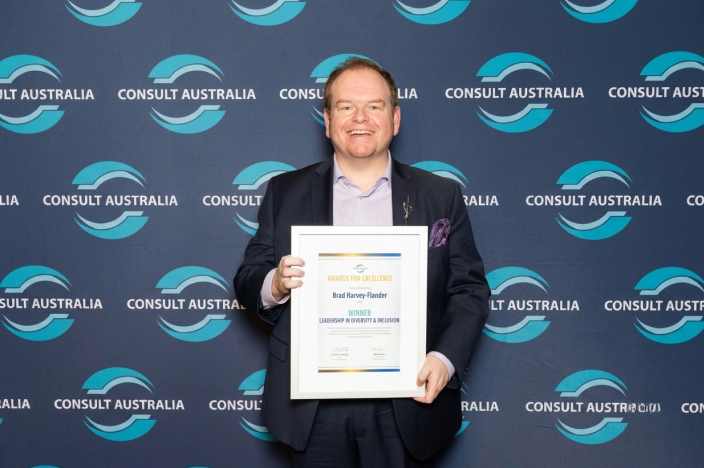
Arup’s Brad Harvey-Fiander won the 2026 Consult Australia Award for Excellence in Leadership in Diversity & Inclusion. Looking back on a decade of championing LGBTQ+ inclusion, he says the biggest changes rarely start with grand gestures.
Shortly after winning the award in March, Brad shared a powerful story on LinkedIn.
“Every year, Arup has a big-bash end of year party and partners are also invited to attend. When I joined the firm in 2010, I left my (then) boyfriend at home as I was not sure that he would be welcome,” he wrote.
“As a millennial with nothing but youthful optimism and a strong sense of social justice, that was the spark that I needed to do something and I had a strong sense that Arup would live its values and meet my challenge. Fast forward to 2026 and I am still at Arup where I think my (now) husband is more popular than I am at those parties.”
In 2016, when Brad established ConnectOut, Arup’s Australian LGBTQ+ employee resource group, Australia hadn’t yet legalised same-sex marriage. Over the ensuing decade, Brad’s work has contributed to inclusive parental leave, changes to family and domestic violence leave, a Gender Affirmation Guide and all-gender bathrooms.
In 2025, Arup was named a Silver Employer at the Australian LGBTQ+ Awards. Brad’s Consult Australia honour adds another accolade to the firm’s collection.
As Arup’s Head of Workplace and Facilities Management for NSW and ACT, Brad leads a team that supports more than 1,000 engineers, designers, planners and consultants. It's a role that has reinforced his belief that inclusion is not shaped solely by policy.
“Inclusion happens in the small moments. Grand gestures are stepping-off points, but they don’t mean anything unless they’re lived in the everyday experience. It’s in the conversation with a colleague. In the visible demonstration of allyship by wearing a lanyard during Pride Month. In the LinkedIn post that costs next to nothing but is a public commitment.”
Culture isn’t built by policy alone
Pride in Diversity’s 2026 Australian Workplace Equality Index (AWEI) employee survey shows 80% of respondents agree that LGBTQ+ inclusion has a positive impact on workplace culture.
But for many organisations, inclusion is still a work in progress. The AWEI survey found LGBTQ+ employees were 11% less likely to feel a sense of belonging and around 10% less likely to feel they could be themselves at work than their non-LGBTQ+ colleagues.
Meaningful change doesn’t always require large budgets, Brad notes.
“Many of Arup’s initiatives are accessible to organisations of every size. Changing a policy generally costs nothing,” Brad says. “The symbolism and the statement that a company makes is so much more powerful than any actual cost.”
Celebrating days of significance can also make a difference. “Pride Month is a great time to talk about what we have achieved over the last 12 months in support of LGBTQ+ inclusion. Wear It Purple Day, which is youth focused, has opened up so many conversations inside our business with heterosexual parents of rainbow youth.
“We are ‘baking in’ intergenerational inclusion, which is really powerful because when people transition from university to their workforce, around 35% go back into the closet because they’re not sure they’ll be accepted.”
Designing inclusion beyond the workplace
Leaders in design companies can play a dual role in supporting inclusion: within their own organisations, and through the infrastructure, buildings and public spaces they help create.
Queering Cities in Australia report, a collaboration between Arup and four university and research partners, illustrates how a commitment to inclusion can translate into practice.
The report introduces a concept of “usualising” inclusion, or “accommodating all genders and sexualities from the start”. The aim isn’t to continually draw attention to difference, but to create environments where people never have to wonder whether they belong.
The report’s recommendations include engaging with LGBTQ+ communities early in consultation, considering how different people and families experience public spaces, and ensuring public art and public places reflect the diversity of the communities they serve.
Brad, who has championed Arup’s report within the industry, sees an opportunity to reframe the familiar Golden Rule. “We’re making a shift from ‘treat others how you want to be treated’ to treating others how they want to be treated.” This is a subtle shift in language, but a profound shift in leadership.