July 2026
Beyond the billable
Jonathan Cartledge, Chief Executive Officer, Consult Australia
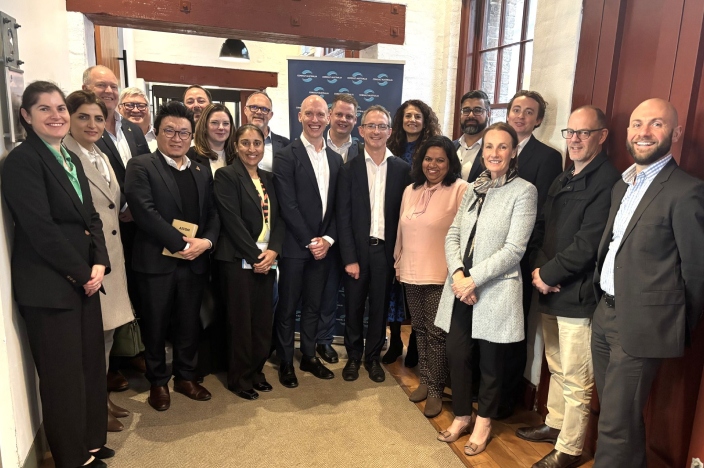 Jonathan Cartledge with Consult Australia members at the Consult Australia NSW Boardroom Luncheon with Mark Westbrook, Chief Project Officer at EnergyCo.
How do you build the firm of the future when you can’t predict the market past November? Each year, Consult Australia’s Market Conditions Survey takes the pulse of our membership. This year, the vital signs are mixed.
More sectors are reporting healthy workloads, yet 78% of members say pipeline uncertainty is their biggest constraint.
Just over half (51%) of businesses are optimistic about the year ahead, but 92% continue to absorb rising business costs rather than passing them on to clients.
And while 41% expect of those surveyed expect the pipeline to grow over the next year, 35% expect it to shrink.
For all the contradictions, there is one area of broad agreement: digital, data and artificial intelligence are the industry’s biggest future skills gap, identified by almost two-thirds of members.
McKinsey’s latest analysis, published this month, estimates that AI could automate 50% of non-physical work in architecture and engineering, and 39% in construction.
But automation isn’t the big story. McKinsey argues the firms that create lasting advantage won’t treat AI as a “superficial productivity tool”. They’ll redesign the way work is delivered, strengthen human judgement where it matters most, and shift from “selling effort to selling excellence”.
This idea is also at the heart of the most recent report from Consult Australia’s North American counterpart, ACEC Research Institute. Rather than asking how firms can simply apply AI more effectively, Redefining the Firm: Talent, Technology and Transformation explores how technology is changing the business models, leadership, talent and the value firms create.
In this month's Consulting Matters, Egis Managing Director and former Consult Australia National President Rowenna Walker makes a similar observation: “What is the value of the advice that we’re providing? Because that’s what the future looks like: getting paid on value, not on hours per person.”
Rowenna isn’t talking about pricing. If AI can produce calculations, drawings and documentation faster than ever before, what becomes more valuable? Judgement, relationships, accountability, creativity, empathy, curiosity, integrity… in other words, human qualities that can’t be replaced by automation.
These are some of the ideas I’ll be taking to the Australian Constructors Association’s Foundations and Frontiers 2026 conference next month, as we consider “next frontiers” alongside our peer associations across the industry.
Our latest Market Conditions Survey suggests that uncertainty isn’t about to abate. While 91% of members who responded have capacity now or expect to within the next six months, the number reporting they have too much work has doubled.
We can’t wait for conditions to become more predictable. We must build the capability, culture and confidence to thrive in uncertainty by creating more value, not simply more billable hours.